On March 29, 2026, the Symposium on Economic Theory Innovation and Policy Frontiers for China’s 15th Five-Year Plan was held at the College of Economic and Social Development of Nankai University. The event was jointly organized by the Institute for Chinese Modernization Studies and the College of Economic and Social Development of Nankai University. More than 20 experts and scholars from institutions including the Chinese Academy of Social Sciences, the Development Research Center of the State Council, Peking University, Nanjing University, Xi’an Jiaotong University, Shandong University, Liaoning University, Capital University of Economics and Business, and Huaqiao University gathered to discuss key topics such as the development of a modern industrial system, macroeconomic laws, the coordinated advancement of technological and industrial innovation, and new quality productive forces.
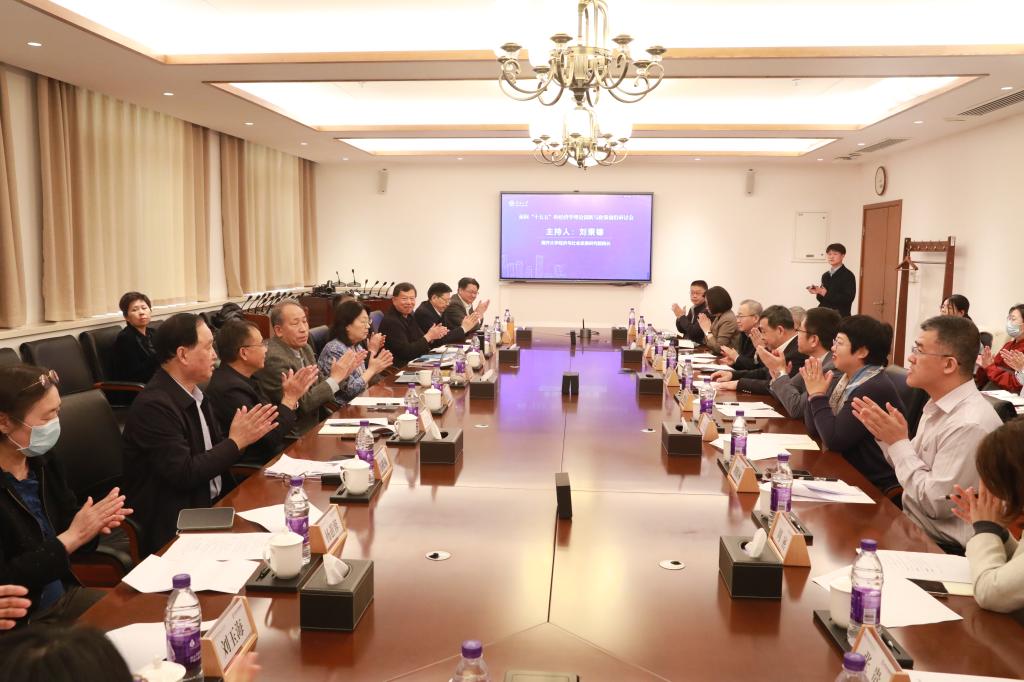
The opening ceremony was chaired by Professor Liu Binglian, Dean of the College of Economic and Social Development at Nankai University. Professor Li Junqing, Party Secretary of the School of Economics at Nankai University, delivered the opening remarks.
The symposium consisted of two sessions.
The first session was chaired by Research Fellow Zhang Yongshan from the Chinese Academy of Social Sciences. Research Fellow Shi Dan of the Chinese Academy of Social Sciences emphasized that building China into a leading energy power requires greater integration and coordination among energy security, information security, and other strategic security domains. Professor Lin Muxi of Liaoning University systematically reviewed the seven core laws of Marxist political economy. Professor Wang Wenju of Capital University of Economics and Business proposed establishing deeper mechanisms for cost-sharing and benefit-sharing to foster integrated commuting networks, functional zones, and industrial clusters in the Beijing-Tianjin-Hebei region. Professor Feng Genfu of Xi’an Jiaotong University argued that applied economics research must shift from merely explaining problems to solving real-world challenges, with a greater focus on systems integration to address practical issues. Professor Fan Conglai of Nanjing University advocated strengthening the role of venture capital as a driving force for innovation and implementing a differentiated and targeted innovation credit system.
The second session was chaired by Professor Guo Kesha of Huaqiao University. Research Fellow Hou Yongzhi of the Development Research Center of the State Council emphasized that the transformation and upgrading of traditional industries remain a key battleground for developing new quality productive forces. Professor Zang Xuheng of Shandong University proposed that narrowing the gaps among China’s three major pension systems and better meeting public welfare needs could create significant opportunities for future development. Professor Yang Huixin of Shandong University discussed practical pathways for using artificial intelligence to support the evolution of new industrial ecosystems. Professor Shen Tiyan of Peking University pointed out that future industrial cluster policies should return to their original purpose by promoting coordinated development among clusters of different sizes and fostering world-class flagship enterprises.