On May 10, 2026, the Symposium on China’s Industrial Economic Development During the 15th Five-Year Plan Period was successfully held at the College of Economic and Social Development (CESD), Nankai University. The event was jointly organized by the Industrial Economic History Committee of the China Industrial Economics Association and the College of Economic and Social Development, Nankai University.
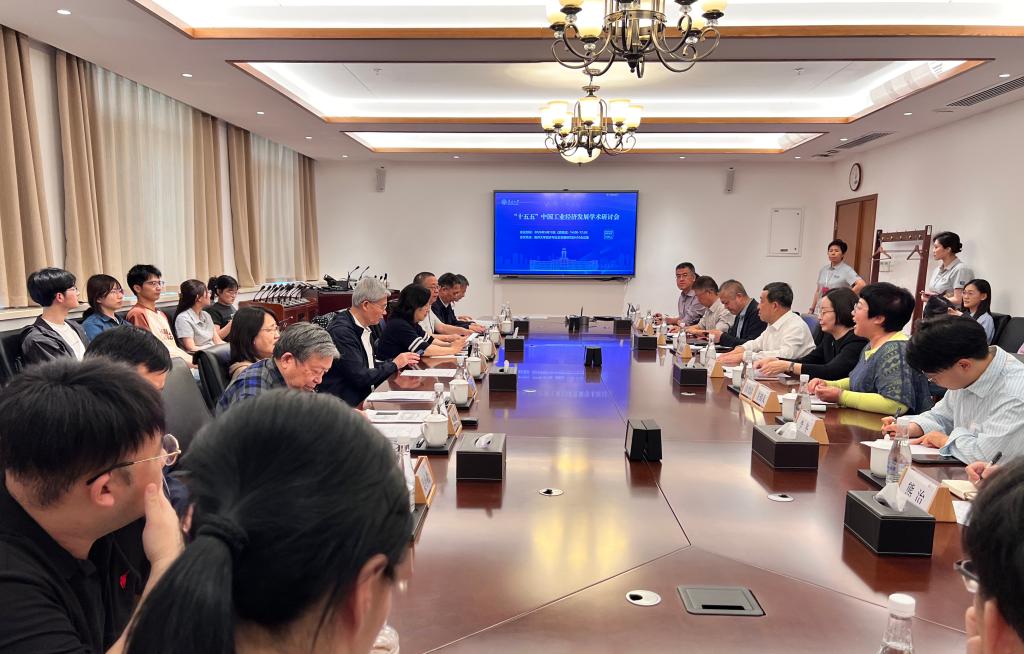
More than 20 scholars and experts from institutions including the Chinese Academy of Social Sciences, Southeast University, Beijing Jiaotong University, Huaqiao University, Hunan University of Science and Technology, Tianjin University of Finance and Economics, Jiangsu College of Economy and Information Technology, and Nankai University gathered to discuss major issues concerning China’s industrial development during the 15th Five-Year Plan period. Key topics included the development of China as an energy powerhouse, the imbalance between strong supply and weak demand, industrial transformation in the digital and intelligent era, the deep integration of technological and industrial innovation, and the evolution of industrial civilization.
The opening ceremony was chaired by Professor Bai Xuejie, Vice Dean of the College of Economic and Social Development. Opening remarks were delivered by Research Fellow Shi Dan, Member of the Academic Divisions of the Chinese Academy of Social Sciences and President of the China Industrial Economics Association, and Professor Liu Binglian, Dean of the College of Economic and Social Development.
The symposium consisted of two discussion sessions.
In the first session, chaired by Professor Bai Xuejie, Research Fellow Shi Dan provided an in-depth analysis of the future direction and implementation pathways for building China into a leading energy power amid the accelerating restructuring of the global energy landscape.
Professor Guo Kesha, Director of the Economic Policy Research Center of the Chinese Academy of Social Sciences and Distinguished Professor at Huaqiao University, argued that addressing the imbalance between strong supply and weak demand requires targeted efforts to stimulate effective demand, deepen income distribution reform, and promote positive interactions between production and consumption.
Professor Li Haijian, former Party Secretary and Deputy Director of the College of Quantitative and Technical Economics at the Chinese Academy of Social Sciences and Professor at the University of Chinese Academy of Social Sciences, emphasized that digital and intelligent transformation is fundamentally reshaping the structure of industrial economies. He noted that data, algorithms, and computing power are becoming key drivers in reconstructing industrial production factors.
Professor You Jin, former Deputy Party Secretary and Chair of the Academic Committee of Hunan University of Science and Technology, examined the emergence of Hangzhou’s artificial intelligence industry cluster and proposed fostering innovation ecosystems as a practical pathway for developing future industries.
The second session was chaired by Professor Liu Weilin, Vice Dean of the College of Economic and Social Development.
Professor Hu Hanhui, Founding Director of the Center for Group Economy and Industrial Organization Studies at Southeast University, reviewed the historical development of Jiangsu’s industrial economy and discussed how the legacy of industrial civilization continues to influence the evolution of modern industrial clusters.
Professor Feng Hua, Dean of the College for Industrial Innovation at Beijing Jiaotong University, emphasized that promoting the deep integration of technological and industrial innovation and accelerating the development of new quality productive forces will be essential for enabling industrial clusters to move up the value chain during the 15th Five-Year Plan period.
Professor Li Shijie, Distinguished Professor at Nankai University, analyzed the mechanisms and pathways through which technological innovation and industrial innovation can be deeply integrated, providing theoretical support for the construction of a modern industrial system.
Professor Du Chuanzhong, Director of the College of Industrial Economics at Nankai University and Vice Chair of the Industrial Economic History Committee, argued that the intelligent economy is becoming a transformative force driving the advancement of China’s new industrialization. He noted that the deep integration of artificial intelligence and manufacturing will further accelerate the high-quality development of China’s new industrialization process.
The symposium provided an important platform for academic exchange on the future of China’s industrial economy and generated valuable insights for industrial development strategies, innovation policy, and economic transformation during the 15th Five-Year Plan period.