To deepen the integration of artificial intelligence into teaching and research and strengthen faculty and students’ ability to use AI agents in office work, CESD partnered with Alibaba Cloud to hold a training session on “Qianwen Office” for educational and research innovation on the morning of October 23, 2026. Organized by the Regional Economic Applications Laboratory, the two-and-a-half-hour session took place in CESD Meeting Room 319 in a hybrid format and attracted more than 100 faculty members and students. Dean Professor Liu Binglian attended, along with Professors Zhou Mi, Zhang Gui, Li Xiang, and Yu Yongze; Assistant Professors Li Na and Wang Ran; postdoctoral researchers Li Dong, Yu Hang, and Xiong Zhi; administrative staff; and doctoral students from all cohorts. Associate Professor Liu Yuhai, Director of the laboratory, chaired the session, which was delivered by Guo Pengcheng, a certified instructor at the Alibaba Cloud Training Center.
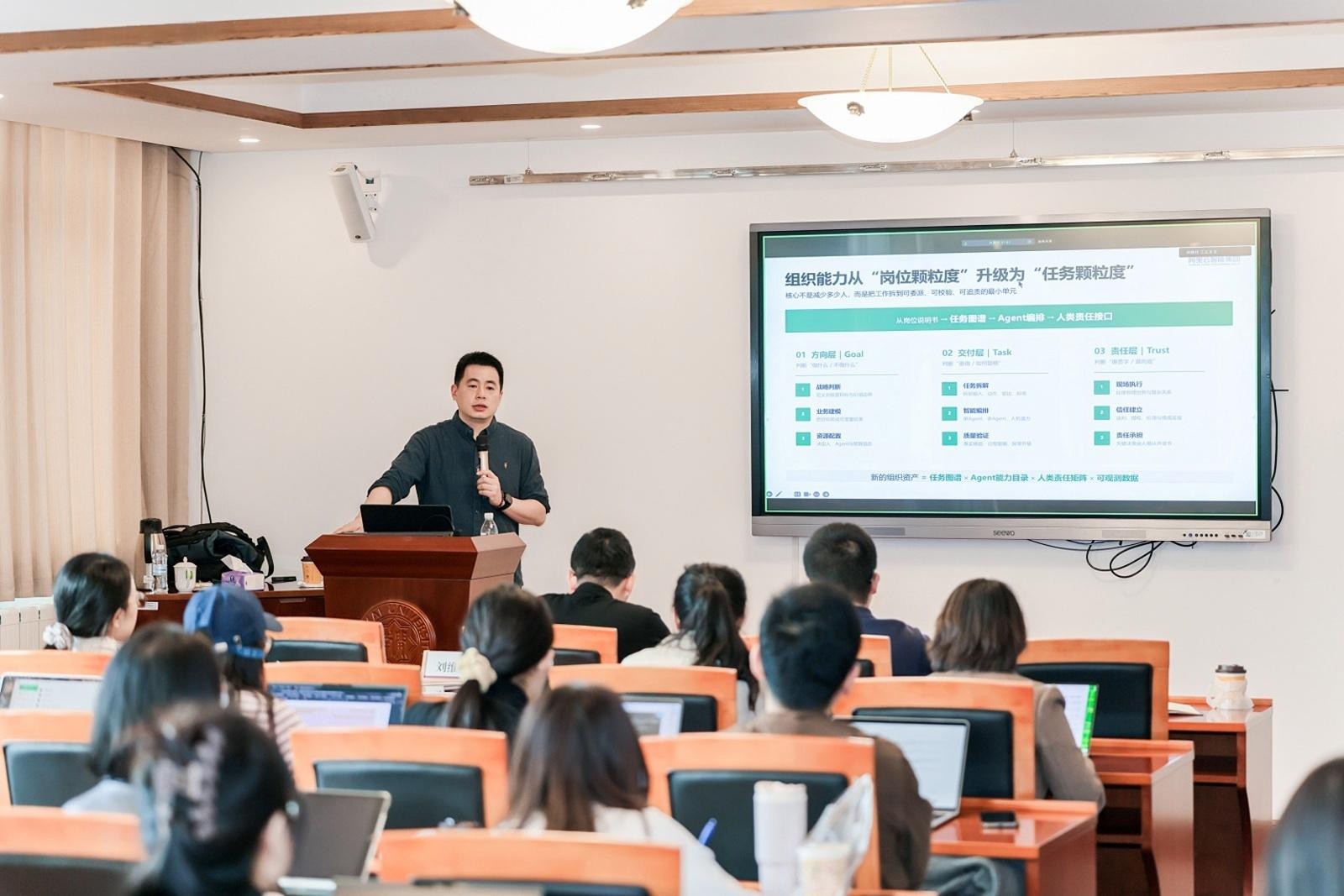
Entitled ‘Coordinating Knowledge, Tools, and AI Agents: Practical Applications of “Qianwen Office” for Innovation in Education and Research,’ the training progressed through three modules: ‘AI Principles, Foundations, and Frontiers,’ ‘Educational and Research Applications and Practical Training,’ and ‘Hands-On Practice and Experience Sharing.’ The aim was to help participants understand both the underlying principles and the practical use of the tools.
Guo Pengcheng began by explaining the technical principles and capability boundaries of large language models, helping participants understand what current AI tools can and cannot yet accomplish. Using the shift from organizing capabilities around job roles to organizing them around tasks as an example, he showed how teaching and research work can be divided into small units that can be delegated, verified, and assigned clear accountability. He then introduced a transferable workflow: define the task, constraints, and context; provide the materials; generate the output; verify it manually; retain the results for reuse; and refine the process iteratively. This gave faculty and students a clear approach for applying the tools to their own research and daily work.
The practical component began with completing one concrete output before expanding to other applications. It comprised four scenarios: forms and reminders, literature and diagrams, data and chart editing, and presentations and reuse. These covered common workflows such as course preparation, literature review, data analysis, visual communication, and teaching presentations. Participants practiced as they learned. Many faculty members raised specific questions related to lesson preparation, student supervision, and research data processing. The instructor worked directly with participants at their laptops, troubleshooting step by step and answering questions on the spot. Engagement remained high throughout the session.
The training was a practical step in CESD’s efforts to integrate AI more deeply into teaching and research, enabling faculty and students to use AI agent tools themselves and complete an entire workflow. The college will continue to organize practical training on AI-supported disciplinary development and provide ongoing assistance through its established technical discussion group, supporting innovation in education and research.